Licensed home inspectors serving Orlando and Central Florida performing wind mitigation inspections

Wind Mitigation Inspection in Central Florida

Licensed Home Inspectors


¡Hablamos Español!

A wind mitigation inspection is a specialized inspection commonly performed on homes throughout Florida.

The inspection documents construction features that may help a home resist high winds and hurricane-related damage.

The completed report can be submitted to the homeowner's insurance company so the insurer can determine whether the property qualifies for available wind mitigation insurance credits or discounts.

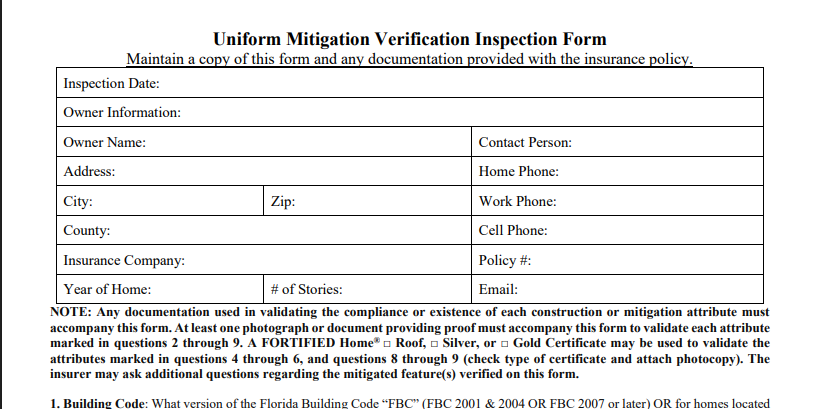
Florida wind mitigation inspections are documented using the Uniform Mitigation Verification Inspection Form OIR-B1-1802.


What Is Checked During a Florida Wind Mitigation Inspection?

A Florida wind mitigation inspection evaluates and documents specific construction features of a home that may affect its ability to resist high winds and hurricane conditions.

The inspection follows the same numbered sections used on Florida's Uniform Mitigation Verification Inspection Form OIR-B1-1802.

1. Building Code

The inspection documents the building code that was in effect when the original permit application for the home was submitted.

Depending on the year and location of the property, the form considers applicable versions of the Florida Building Code or, for qualifying properties within the High-Velocity Hurricane Zone, the applicable South Florida Building Code.

2. Region

The property is classified according to its design wind-speed region.

The current Florida form includes the High-Velocity Hurricane Zone (HVHZ), Region 1, Region 2 and Region 3.

3. Roof Slope

The slope of the main roof is documented as part of the inspection.

For single-family homes with more than one roof slope, the form uses the slope representing at least two-thirds of the main roof area when determining the applicable classification.

4. Roof Covering

We identify the roof covering materials installed on the property.

These may include asphalt or fiberglass shingles, concrete or clay tile, synthetic or composite tile, metal roofing, built-up roofing, membrane roofing or other roofing systems.

When the information can be verified, the report may also document the roof permit application date, Florida or Miami-Dade product approval information and the year of original installation or replacement.

5. Roof Deck Attachment

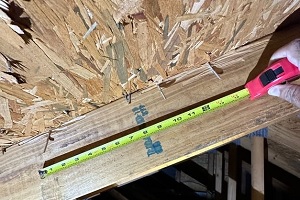
The inspection evaluates the weakest form of attachment between the roof deck and the roof trusses or rafters.

Roof sheathing, decking material, nail size, nail spacing and other approved fastening methods are considered when documenting this section of the form.

6. Roof-to-Wall Attachment

The inspection identifies the weakest roof-to-wall connection observed on the structure.

Depending on the construction, the connection may be classified as toenails, clips, single wraps, double wraps, structural attachment or another documented connection method.

7. Roof Geometry

The shape and configuration of the roof are documented during the inspection.

The Florida form classifies the roof as a qualifying hip roof, qualifying flat roof or other roof geometry.

8. Sealed Roof Deck / Secondary Water Resistance (SWR)

The inspection determines whether the home has a qualifying sealed roof deck or Secondary Water Resistance system.

These systems are intended to provide supplemental protection against water intrusion if the primary roof covering is damaged or lost during a storm.

9. Opening Protection

The inspection evaluates the weakest form of wind-borne debris protection installed on the structure.

Applicable openings include windows, entry doors, garage doors, skylights and other wall or roof openings covered by the form.

Depending on the property, protection may include verified impact-resistant products, approved shutters or other documented protective systems.

Inspection Photographs and Documentation

Supporting photographs and documentation are an important part of a Florida wind mitigation inspection.

The Florida form requires supporting evidence for applicable attributes reported in Questions 2 through 9.

Available permits, product approvals, photographs and other documentation may be used to verify those construction features.

How Long Is a Florida Wind Mitigation Form Valid?

The Florida OIR-B1-1802 verification form may remain valid for up to five years, provided no material changes have been made to the structure and no inaccuracies are found on the form.


Florida Wind Mitigation Form OIR-B1-1802

Our wind mitigation inspections are documented using Florida's Uniform Mitigation Verification Inspection Form OIR-B1-1802, Revision 04/26.

Homeowners, Realtors and insurance professionals can review the Florida wind mitigation inspection form below.

Florida Uniform Mitigation Verification Inspection Form OIR-B1-1802

View the Florida Wind Mitigation Inspection Form OIR-B1-1802


¿Qué se revisa durante una Inspección de Mitigación de Vientos?

Una Inspección de Mitigación de Vientos en Florida documenta ciertas características de construcción de una vivienda que pueden influir en su capacidad para resistir vientos fuertes y condiciones asociadas con huracanes.

La información se presenta siguiendo las mismas secciones numeradas del formulario oficial Uniform Mitigation Verification Inspection Form OIR-B1-1802.

1. Código de Construcción (Building Code)

La inspección documenta el código de construcción que estaba vigente cuando se presentó la solicitud del permiso original de la vivienda.

Dependiendo del año y la ubicación de la propiedad, el formulario considera las versiones correspondientes del Florida Building Code y, cuando aplica dentro de la High-Velocity Hurricane Zone, el código correspondiente del sur de Florida.

2. Región de Vientos (Region)

La propiedad se clasifica de acuerdo con la región de velocidad de viento de diseño correspondiente.

El formulario actual incluye High-Velocity Hurricane Zone (HVHZ), Region 1, Region 2 y Region 3.

3. Pendiente del Techo (Roof Slope)

La pendiente del techo principal se documenta como parte de la inspección.

En viviendas unifamiliares con varias pendientes, el formulario considera la pendiente que representa por lo menos dos terceras partes del área principal del techo para determinar la clasificación correspondiente.

4. Cubierta del Techo (Roof Covering)

Identificamos los materiales utilizados como cubierta del techo.

Estos pueden incluir shingles de asfalto o fibra de vidrio, tejas de concreto o arcilla, tejas sintéticas o compuestas, techos metálicos, sistemas built-up, membranas u otros tipos de cubierta.

Cuando la información puede verificarse, también pueden documentarse la fecha de solicitud del permiso del techo, las aprobaciones de producto de Florida o Miami-Dade y el año de instalación original o reemplazo.

5. Fijación del Roof Deck (Roof Deck Attachment)

La inspección evalúa la forma más débil de fijación entre el roof deck y las cerchas o vigas del techo.

El material del roof deck, el tipo y tamaño de los clavos, su espaciamiento y otros métodos aprobados de fijación se consideran al documentar esta sección.

6. Conexión entre el Techo y las Paredes (Roof-to-Wall Attachment)

La inspección identifica la conexión más débil observada entre la estructura del techo y las paredes de la vivienda.

Dependiendo de la construcción, puede clasificarse como toenails, clips, single wraps, double wraps, conexión estructural u otro método documentado.

7. Geometría del Techo (Roof Geometry)

La forma y configuración del techo se documentan durante la inspección.

El formulario de Florida clasifica el techo como hip roof que califica, flat roof que califica u otra geometría de techo.

8. Sellado del Roof Deck / Resistencia Secundaria al Agua (SWR)

La inspección determina si la vivienda cuenta con un sistema que califique como Sealed Roof Deck o Secondary Water Resistance (SWR).

Estos sistemas proporcionan protección suplementaria contra la entrada de agua si la cubierta principal del techo se daña o se pierde durante una tormenta.

9. Protección de Aberturas (Opening Protection)

La inspección evalúa la forma más débil de protección contra escombros impulsados por el viento instalada en la estructura.

Las aberturas aplicables incluyen ventanas, puertas de entrada, puertas de garaje, tragaluces y otras aberturas de paredes o techo incluidas en el formulario.

Dependiendo de la propiedad, la protección puede incluir productos resistentes a impactos verificados, shutters aprobados u otros sistemas de protección documentados.

Fotografías y Documentación de la Inspección

Las fotografías y documentos de respaldo son una parte importante de la Inspección de Mitigación de Vientos.

El formulario de Florida requiere evidencia de respaldo para los atributos correspondientes reportados en las preguntas 2 a 9.

Permisos, aprobaciones de productos, fotografías y otros documentos disponibles pueden utilizarse para verificar esas características.

¿Por Cuánto Tiempo es Válido el Formulario?

El formulario OIR-B1-1802 puede permanecer válido hasta por cinco años, siempre que no se hayan realizado cambios materiales en la estructura y no se encuentren inexactitudes en el formulario.


Formulario de Mitigación de Vientos de Florida OIR-B1-1802

Nuestras Inspecciones de Mitigación de Vientos se documentan utilizando el formulario Uniform Mitigation Verification Inspection Form OIR-B1-1802 de Florida, revisión 04/26.

Propietarios, Realtors y profesionales de seguros pueden consultar el formulario utilizado para las inspecciones en el siguiente enlace.

Formulario de Inspección de Mitigación de Vientos de Florida OIR-B1-1802

Ver el Formulario de Inspección de Mitigación de Vientos de Florida OIR-B1-1802


We perform Wind Mitigation Inspections in:

Altamonte Springs
Altoona
Apopka
Celebration
Clermont
Davenport
Deland
Eustis
Haines City
Intercession
Kissimmee
Lake Alfred
Lakeland
Lake County
Orange
Orlando
Osceola
Polk County
Polk City
Poinciana
Saint Cloud
Sorrento
Winter Haven
Winter Park


Osceola County Florida cities:

Celebration, FL, Intercession, FL, Kenansville, FL, Kissimmee, FL, Saint Cloud, FL.


Osceola County Florida zip codes: 33848, 34739, 34741, 34742, 34743, 34744, 34745, 34746, 34747, 34758, 34759, 34769, 34770, 34771, 34772, 34773.


Orange County Florida cities:

Apopka, FL, Bithlo, FL, Christmas, FL, Clarcona, FL, Gotha, FL, Killarney, FL, Maitland, FL, Oakland, FL, Ocoee, FL, Orlando, FL, Plymouth, FL, Tangerine, FL, Union Park, FL, Windermere, FL, Winter Garden, FL, Winter Park, FL, Zellwood, FL.


Orange County Florida zip codes: 32703 (Seminole), 32704, 32709, 32710, 32712, 32751, 32768, 32777, 32789, 32790, 32792, 32793, 32794, 32798, 32801, 32802, 32803, 32804, 32805, 32806, 32807, 32808, 32809, 32810, 32811, 32812, 32814, 32816, 32817, 32818, 32819, 32829, 32821, 32822, 32824, 32825, 32826, 32827, 32828, 32829, 32830, 32831, 32832, 32833, 32834, 32835, 32836, 32837, 32839, 32853, 32854, 32855, 32856, 32857, 32858, 32859, 32860, 32861, 32862, 32867, 32868, 32869, 32872, 32877, 32878, 32885, 32886, 32887, 32891, 32896, 32897, 34734, 34740, 34760, 34761, 34777, 34778, 34786, 34787.


Polk County Florida cities:

Altura, FL, Auburndale, FL, Babson Park, FL, Bartow, FL, Bradley, FL, Davenport, FL, Dundee, FL, Eagle Lake, FL, Eaton Park, FL, Fort Meade, FL, Frostproof, FL, Haines City, FL, Highland City, FL, Homeland, FL, Indian Lake Estates, FL, Kathleen, FL, Kissimmee, FL, Lake Alfred, FL, Lake Hamilton, FL, Lake Wales, FL, Lakeland, FL, Lakeshore, FL, Loughman, FL, Mulberry, FL, Nalcrest, FL, Nichols, FL, Polk City, FL, River Ranch, FL, Waverly, FL, Winter Haven, FL.


Polk County Florida zip codes: 33801, 33802, 33803, 33804, 33805, 33806, 33807, 33809, 33810, 33811, 33812, 33813, 33815, 33820, 33823, 33827, 33830, 33831, 33835, 33836, 33837, 33838, 33839, 33840, 33841, 33843, 33844, 33845, 33846, 33847, 33849, 33850, 33851, 33853, 33854, 33855, 33856, 33858, 33859, 33860, 33863, 33867, 33868, 33877, 33880, 33881, 33882, 33883, 33884, 33885, 33888, 33896, 33897, 33898, 34759.


Lake County Florida cities:


Altoona, FL, Astatula, FL, Astor, FL, Clermont, FL, Eustis, FL, Ferndale, FL, Fruitland Park, FL, Grand Island, FL, Groveland, FL, Howey in the Hills, FL, Lady Lake, FL, Leesburg, FL, Mascotte, FL, Minneola, FL, Montverde, FL, Mount Dora, FL, Hokahumpka, FL, Paisley, FL, Sorrento, FL, Tavares, FL, Umatilla, FL, Yalaha, FL.


Lake County Florida zip codes: 32102, 32158, 32159, 32702, 32726, 32727, 32735, 32736, 32756, 32757, 32767, 32776, 32778, 32784, 34705, 34711, 34712, 34713, 34714, 34715, 34729, 34731, 34736, 34737, 34748, 34749, 34753, 34755, 34756, 34762, 34788, 34789, 34797.

Wind mitigation and 4-point inspection in Central Florida

Wind Mitigation & 4-Point Inspections


HUD/FHA mobile home foundation certification in Florida

Mobile Home Foundation Certification


WDO and termite inspection in Central Florida

WDO/Termite Inspection


Home inspector quote

Get a Quote for a
General Home Inspection


Certificate of Insurance

Certificate of Insurance


Association of Realtors in Osceola County

Association of Realtors in Osceola County


Home Inspector and American Red Cross volunteer

American Red Cross Volunteer


Follow us on Facebook
Follow us on Twitter
Follow us on Instagram


Better Business Bureau Accredited Business


Inspectors in Central Florida LLC

Professional Home Inspection Services
Serving Orlando & Central Florida
Hablamos Español


(407)535-3195


inspectorsincentralflorida@gmail.com


Sitemap


Copyright © 2026 Inspectors in Central Florida LLC. All Rights Reserved.

Text Home Inspector 407-535-3195 Call Home Inspector 407-535-3195